

Short answer: $500,000 does not have a fixed expiry date. If you withdrew $50,000 a year and earned no investment return, it would last 10 years. At $30,000 a year, it would last approximately 16.7 years.
Real retirement planning is more complex. Your investment returns, fees, inflation, Age Pension eligibility, housing costs, other income and changing spending will all affect how long your savings last.
How long will $500,000 last at different withdrawal levels?
The table below provides a simple starting point. It divides $500,000 by the annual amount withdrawn from the portfolio.
These figures are simple arithmetic, not a retirement forecast. They exclude investment returns, inflation, fees, tax, Age Pension payments, other income and changes to your withdrawals.
The amount you spend is also different from the amount you need to withdraw from your savings. If the Age Pension, employment income, an annuity, rental income or another source covers part of your budget, your $500,000 may need to fund only the remaining gap.
Is $500,000 enough for retirement in Australia?
It may be, but “enough” depends on the life you want to fund.
The ASFA Retirement Standard provides useful Australian benchmarks. Its March quarter 2026 figures for couples aged 65 to 84 are:
ASFA’s lump-sum estimates assume retirees draw down their capital and receive a part Age Pension. They are broad benchmarks, not personal recommendations.
For a couple retiring at 67, a $500,000 balance sits below ASFA’s comfortable savings benchmark but well above its modest homeowner benchmark. Whether it is enough will depend on your housing position, desired spending and access to other income.
How the Age Pension changes the calculation
The Age Pension can significantly reduce the amount that needs to be withdrawn from retirement savings.
As at 4 August 2026, the maximum combined Age Pension for a couple is $1,810.40 per fortnight, or approximately $47,070 a year. This includes the maximum Pension Supplement and Energy Supplement. However, the actual amount received depends on both the income and assets tests. Services Australia publishes the current payment rates here.
From 1 July 2026, the assets-test thresholds for a couple are:
These limits apply to the couple’s combined assessable assets, not just their superannuation. The income test also applies. Current thresholds are available from Services Australia.
For example, a homeowner couple with exactly $500,000 in total assessable assets would sit only $1,000 above the assets threshold for the maximum pension. In practice, most households also hold other assessable assets, so a $500,000 super balance does not automatically translate into a particular pension payment.
Your Age Pension eligibility may also change as your assets, income and circumstances change throughout retirement.
The 6 factors that determine how long $500,000 lasts
1. Your actual spending
A difference of $10,000 a year can materially change the outcome over a long retirement.
Start with your own spending rather than a general benchmark. Separate it into:
- Essential expenses such as housing, food, utilities, transport and healthcare
- Flexible spending such as travel, entertainment and gifts
- Larger irregular expenses such as replacing a car, renovating or helping family
This makes it easier to see which costs must always be funded and which could change during difficult investment periods.
2. Your housing position
A homeowner without a mortgage may have very different retirement needs from someone paying rent, a mortgage or substantial strata costs.
This is particularly important when planning retirement in Sydney. Include mortgage or rent payments, council rates, strata fees, insurance, repairs and ongoing maintenance as separate items in your projection.
3. Investment returns
Keeping retirement savings invested may help them last longer, but returns are not consistent or guaranteed.
The order in which returns occur also matters. A significant market fall early in retirement can be particularly damaging if you need to sell investments while their value is lower. This is known as sequence-of-returns risk.
A useful projection should test several return scenarios rather than assume the same return every year.
4. Inflation
Inflation reduces what your money can buy over time.
At inflation of 2.5% a year, a lifestyle costing $50,000 today would cost approximately $64,000 in 10 years. If withdrawals do not increase, your spending power may gradually fall.
Retirement projections should therefore show spending in today’s dollars or clearly explain how inflation has been included.
5. Fees, tax and one-off costs
Investment fees, administration fees and tax can reduce the return available to fund retirement.
Large one-off costs can also change the result. These might include healthcare, home repairs, replacing a vehicle, family support or aged care. A sound plan should allow for these expenses rather than assuming spending will remain perfectly even.
6. How long you need to plan for
Retiring at 60 creates a different calculation from retiring at 70. Couples should also consider the possibility that one person may live considerably longer than the other.
The objective is not simply to make the balance reach an average life expectancy. It is to create a plan that remains resilient if retirement lasts longer than expected.
Does retiring in Sydney change the answer?
Your location affects your spending, especially your housing costs.
A Sydney homeowner without a mortgage may be able to direct more of their budget towards travel and lifestyle. Someone renting, carrying a mortgage or paying substantial strata costs may require a larger annual income.
Rather than applying a generic “Sydney adjustment”, use your actual rent, mortgage, rates, strata, maintenance and transport costs. This will produce a more useful result than relying on a national average.
How to build a more reliable retirement projection
A useful retirement projection should bring together:
- Your desired annual spending in today’s dollars
- Your current superannuation and other investments
- Your estimated Age Pension entitlement
- Income from work, property, annuities or other sources
- Investment returns after fees
- Inflation and rising living costs
- Large planned or unexpected expenses
- Several market and longevity scenarios
The Moneysmart account-based pension calculator can provide a useful initial estimate of how returns and fees may affect an account-based pension. Its results are illustrations rather than predictions, and its calculation does not include Age Pension payments or investments outside the pension account.
Practical ways to make your retirement savings more resilient
You may be able to improve the longevity of your savings by:
- Separating essential spending from flexible lifestyle spending
- Coordinating withdrawals with Age Pension and other income
- Keeping suitable liquidity available for near-term expenses
- Avoiding large unplanned withdrawals where possible
- Reviewing investment risk rather than moving everything automatically into cash
- Testing how the plan responds to weaker early returns or higher inflation
- Reviewing the strategy each year and after major life changes
The strongest retirement plans are not based on one perfect prediction. They provide clear spending boundaries and practical choices if circumstances change.
Frequently asked questions
How long will $500,000 last if I withdraw $50,000 a year?
With no investment return, inflation, fees, tax or other income, $500,000 would last 10 years. In practice, your invested balance, Age Pension eligibility and changing withdrawals would affect the result.
Can a couple retire with $500,000?
Potentially. ASFA’s current benchmark places $500,000 between its modest and comfortable savings estimates for a couple retiring at 67. Housing, spending and Age Pension eligibility will determine whether it supports the lifestyle the couple wants.
Can a single person retire with $500,000?
Potentially. ASFA’s savings benchmarks at age 67 are $110,000 for a modest homeowner retirement and $630,000 for a comfortable retirement for a single person. These estimates assume capital is drawn down and some Age Pension is received.
Can a couple with $500,000 receive the Age Pension?
They may qualify for a full or part Age Pension, but the exact payment depends on homeownership, combined assessable assets, income, relationship circumstances and other eligibility requirements. A super balance alone is not enough to determine the result.
Should retirement savings be kept entirely in cash?
There is no single answer for everyone. Cash can provide stability for near-term spending, but holding too much for a long period may increase inflation and longevity risk. The appropriate mix depends on your spending needs, timeframe and comfort with investment risk.
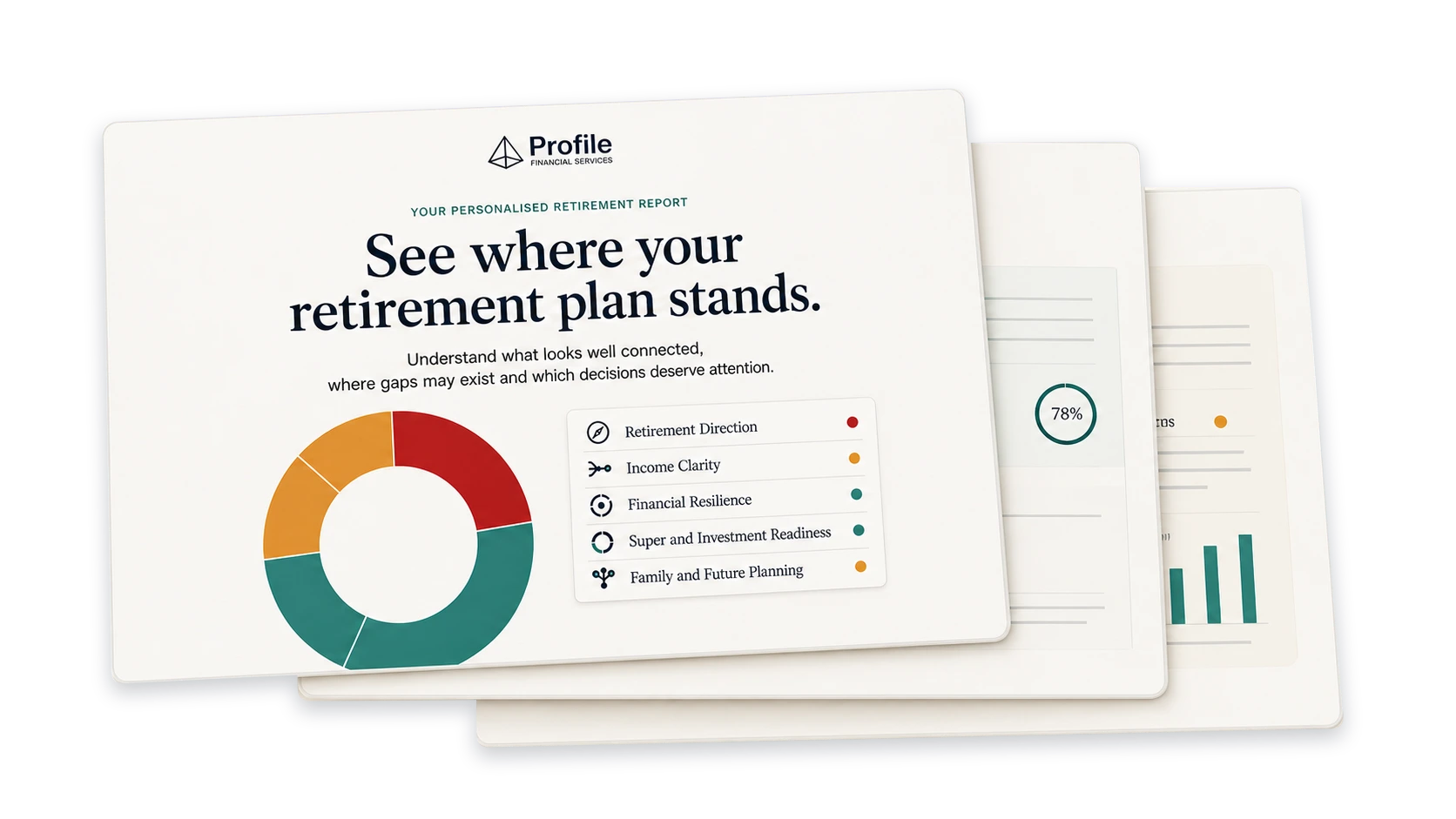
See how prepared you are for retirement
Complete our 4-minute Retirement Strategy Diagnostic to understand where your plan is strongest and what may deserve attention next.
.avif)