

.jpg)
You can retire at any age, but you need to have access to the money you plan to use, and these assets need to support spending for your full retirement ahead.
Reaching 60 does not guarantee these two outcomes. You need to separate three decisions:
- When work stops,
- When super is available,
- And whether the plan remains affordable through different markets and life events.
For many Australians, 60 is their preservation age. Access to preserved super still depends on meeting a condition of release.
Age Pension age is currently 67 and eligibility also depends on income, assets and residence rules.
Three questions, not one
When can you access super at 60?
The maximum preservation age is 60 for anyone born from 1 July 1964. Reaching preservation age alone does not always provide unrestricted access.
Common pathways include:
- reaching preservation age and retiring under the super rules;
- ending an employment arrangement after turning 60, which can release benefits linked to the relevant rules;
- using a transition-to-retirement income stream while continuing to work, subject to restrictions; or
- reaching age 65, when super can generally be accessed even if you continue working.
Your superannuation fund must apply the law and its governing rules. Confirm your position with the superannuation fund before relying on a withdrawal date. Defined benefit and untaxed public-sector arrangements can have additional scheme and tax rules.
The seven numbers to calculate
1. Core annual spending
Start with what your life costs, not a generic retirement standard. Separate:
- essential household spending;
- discretionary travel, hobbies and entertainment;
- housing costs;
- health and insurance;
- family support; and
- irregular expenses such as cars, renovations and major dental work.
Use today's dollars and record what could change if markets or health costs move against you.
2. Accessible assets at 60
List cash, investments, super that will be available, property proceeds you genuinely plan to realise and other assets. Keep illiquid or uncertain values separate.
Do not count a business valuation, future inheritance or property sale as cash unless the timing and net proceeds have been tested.
3. Super that remains unavailable
If any super cannot be accessed at the planned date, record when and how it may become available. This can apply to scheme-specific defined benefits, employment arrangements or preserved components.
The purpose is to avoid a plan that is solvent on paper but short of cash in the first years.
4. Debt at retirement
Record the balance, interest rate, repayment and proposed treatment of every debt. Paying debt before retirement can reduce spending needs, but using a large amount of capital can also reduce liquidity and future investment income.
Model both choices before assuming one is better.
5. Other reliable income
Include rent after realistic costs, defined benefit pensions, annuities, part-time work and other income. Treat variable income conservatively and distinguish contractual income from an estimate.
For Age Pension, use a separate eligibility estimate based on current Services Australia rules. Do not add the maximum rate to the plan by default.
6. The bridge to age 67
Someone retiring at 60 faces seven years before current Age Pension age. Calculate the spending and major costs that must be funded during this period, allowing for investment returns, tax and inflation.
This bridge is not merely seven times annual spending. Markets will move, cash flows occur at different times and some assets may remain invested. The calculation should form part of a year-by-year model.
7. Your contingency margin
A retirement plan needs room for outcomes that do not follow the central estimate. Test:
- a market fall early in retirement;
- higher inflation;
- living longer than expected;
- a large home or health expense;
- less part-time income;
- family support; and
- a lower, later or no Age Pension entitlement.
Your margin may come from lower starting withdrawals, flexible spending, cash reserves, later retirement, part-time work or additional assets. It should be visible rather than assumed.
A retirement-at-60 worksheet
The worksheet organises the inputs. It does not determine a safe retirement date without modelling tax, investment returns, inflation and longevity.
A hypothetical decision
Consider a 60-year-old couple with substantial super, a mortgage and plans for several years of travel. One partner will stop work immediately; the other may consult for two years.
Their decision is not answered by the combined super balance. They need to know:
- which super benefits are accessible after each employment arrangement ends;
- whether to repay the mortgage or retain more liquid capital;
- how much travel spending is temporary;
- how the plan works if consulting income does not occur;
- whether future Age Pension eligibility is plausible; and
- how they would respond to a market fall in the first three years.
The same balance could support or fail to support retirement depending on these choices. This example is illustrative only.
What a robust model should show
Ask for a model that makes the assumptions visible and compares:
- retirement at 60, 62 and 65;
- expected and lower investment returns;
- current and higher spending;
- debt repayment options;
- different Age Pension outcomes;
- one-off capital expenses; and
- a long-life scenario.
The output should show decision ranges, not a precise prediction of the age at which money runs out.
Common mistakes
- Starting with a benchmark instead of your spending.
- Treating all super as immediately accessible.
- Assuming super payments are always tax-free after 60, despite possible untaxed or defined benefit components.
- Counting the family home as retirement funding without a genuine plan to use it.
- Adding Age Pension from 67 without testing income and assets.
- Using one average investment return and ignoring the order of returns.
- Leaving no room for irregular expenses or family support.
When advice helps
Personal advice can be useful when retirement is close, the plan depends on a business or property sale, you have a defined benefit, there is material debt, assets sit across several structures or a partner will retire at a different time.
A financial adviser can coordinate cash flow, super, investment, retirement income and Age Pension scenarios.
A registered tax agent should confirm tax treatment, and your super fund should confirm access and scheme rules.
Test the date before you commit to it
Our expert Sydney-based financial advisers can help you turn the seven numbers into a retirement model that tests timing, spending, markets and the unexpected.
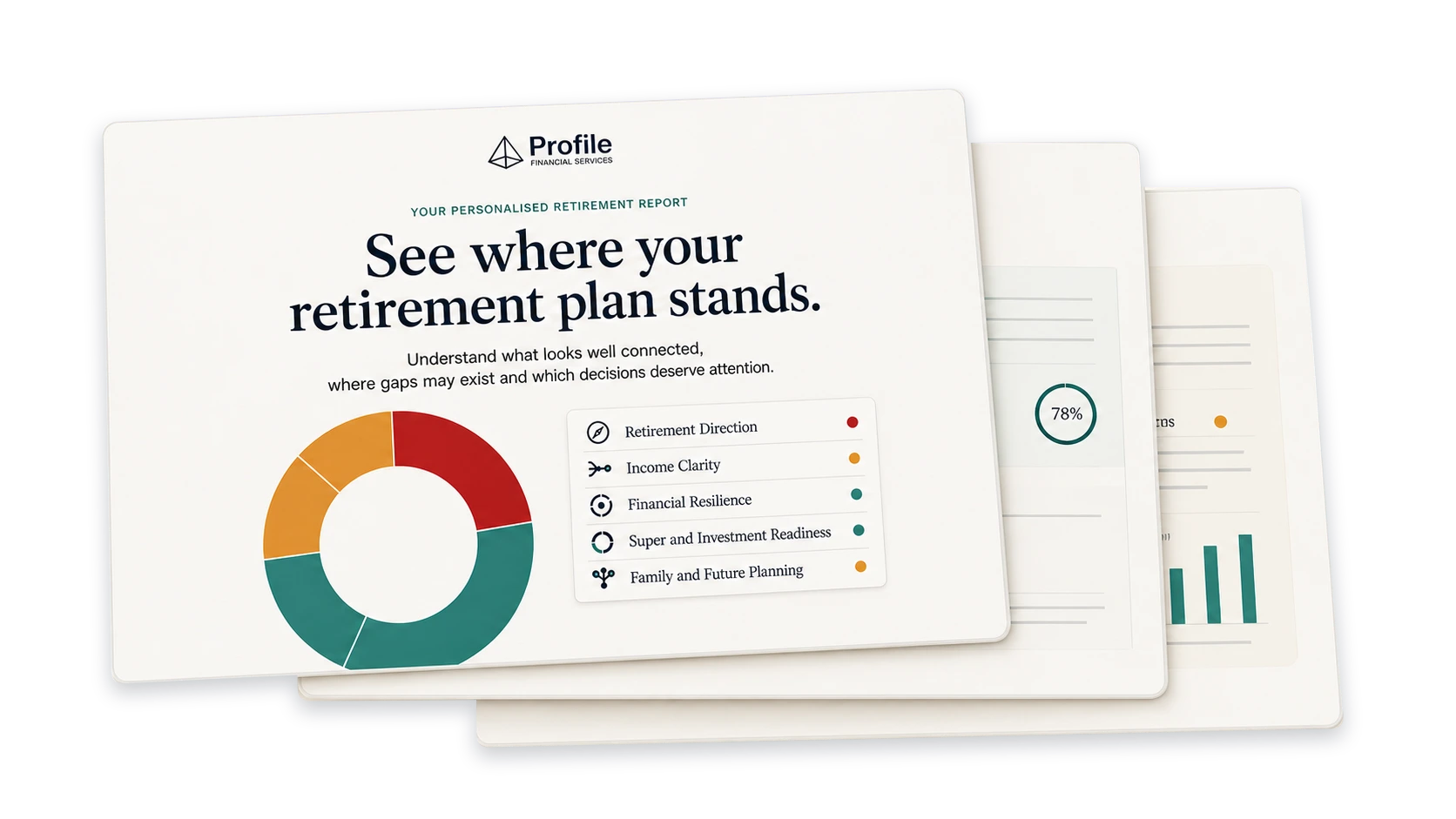
Arrange a retirement planning conversation with our team, or alternatively, take our Retirement Strategy Diagnostic to get a personalised report on your current plan.
Phillip Win is a Certified Financial Planner® at Profile Financial Services who has worked in financial planning since 1995. With qualifications in economics, statistics and financial planning, he takes a practical, common-sense approach to solving complex problems and helping clients achieve their personal and financial goals.
.avif)